Desk report
Jensen Huang is out at Nvidia. What AMD holders gained this week, and what they did not
AMD rose 23% in three sessions while Nvidia fell 7%. Most of that was AMD recovering from its own fall. Here is what the record supports, what the rally costs, and what to watch next.
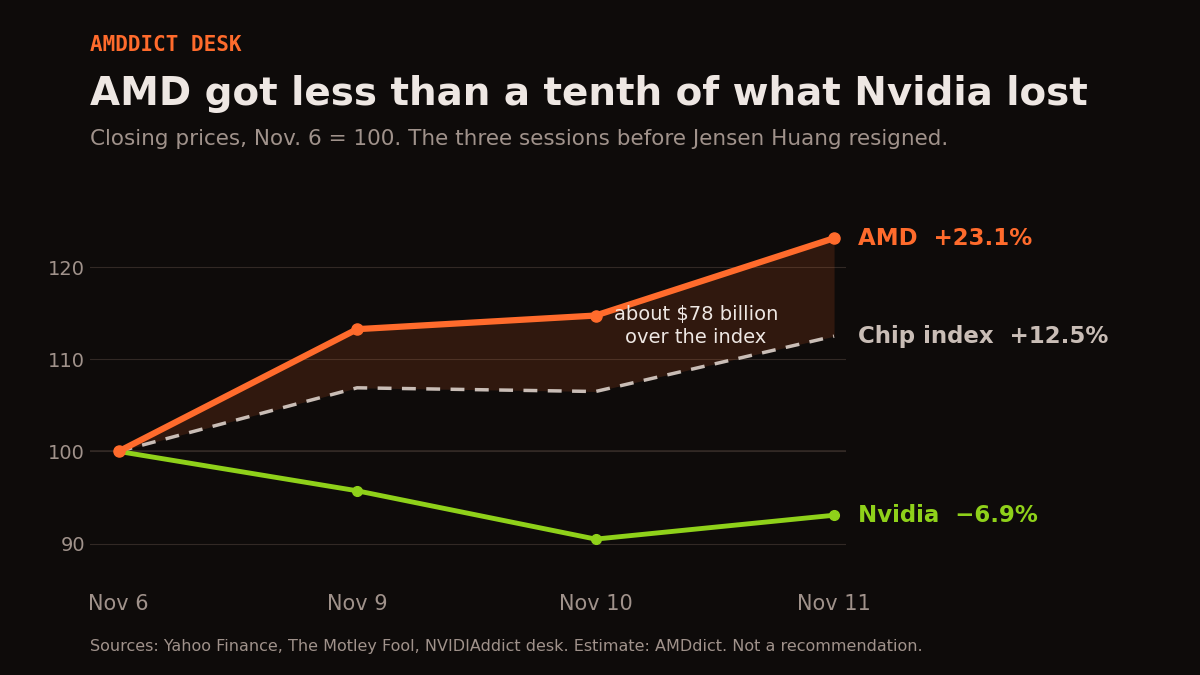
Jensen Huang resigned as Nvidia's chief executive on Thursday morning. AMD shareholders had already been paid for it. In the three sessions before the announcement AMD rose 23% while Nvidia fell 7%.
The question for an AMD holder is what that 23% was a payment for. It was not for orders. No customer has said it is moving a dollar from Nvidia to AMD. AMD has said nothing about its rival. And nine days ago AMD told investors that it cannot build what it has already sold fast enough.
This piece takes AMD's week apart: how much of the move was the stock recovering from its own fall, how much can fairly be credited to Nvidia's trouble, and what in AMD's business was already decided before any of it. The Nvidia side of the story, document by document, is in our sister desk's timeline.
The week in AMD's share price
AMD reported a record quarter after the close on Tuesday, Nov. 3. What followed had little to do with the quarter.
The Nov. 5 fall was the kind of day a concentrated holder remembers: down 17% on 71 million shares, about three times a normal session, on no company news at all. The Motley Fool's market wrap for Nov. 11 describes chip stocks as starting to "put the post-election sell-off behind them." So the first job of this week's rally was to repair that.
To see what is left over, measure AMD against its sector and against Nvidia across the same dates.
| Period | AMD | Nvidia | Chip index (SOX) |
|---|---|---|---|
| Oct. 28 to Nov. 6 | −22.4% | −13.3% | −19.6% |
| Nov. 6 to Nov. 11 | +23.1% | −6.9% | +12.5% |
| Oct. 28 to Nov. 11 | −4.4% | −19.3% | −9.6% |
Two things stand out. Over the full two weeks AMD has done better than its sector by about five points and better than Nvidia by about fifteen. And nearly all of that came in the last three sessions, after Huang's Nov. 8 message to Nvidia's employees turned a story about an intelligence finding into a question about who would be running the company.
Desk analysis Had AMD simply tracked the chip index from the Nov. 6 close, it would have ended Wednesday near $505. It closed at $552.90. That gap of about $48 a share, across 1.636 billion basic shares, is roughly $78 billion. Call it the price the market has put on AMD's position as the alternative.
On Thursday, after the resignation, AMD was at $568.33 at 10:42 a.m. Eastern, up 2.8%, while Nvidia was down 5.0%, Investing.com reported. Those are intraday prices and will be replaced with the close.
What AMD had already told you
The useful question about a rival's crisis is what it changes in your own company's numbers. For the next two quarters the honest answer is: very little, because AMD's limit is supply.
The fourth quarter is sold. The guide of about $17 billion is 27% above the third quarter. If the data center segment grows about 50% from $8.546 billion, as Hu said on the call, it lands near $12.8 billion in a single quarter. Su was asked directly whether demand is running ahead of what AMD can ship and answered that it is.
Inventory says the same thing. Inventories rose to $11.463 billion at the end of September, up 35% in one quarter. A company that expected demand to appear because a competitor stumbled would not already be holding that much. AMD built it for racks its customers had ordered.
Next year was already described as a step change. Su told analysts AMD now expects revenue to grow more than 80% in 2027, with the data center AI business more than doubling. Desk analysis If the fourth quarter lands on the guide, 2026 revenue comes to roughly $52 billion, which would put the 2027 figure she described somewhere above $94 billion. That arithmetic is ours, not AMD's.
A customer that wanted to move a large order from Nvidia to AMD this month would be asking for parts AMD says it does not have. Jay Goldberg of Seaport Research Partners made the mirror-image point about Nvidia to 24/7 Wall St.: Nvidia is "sold out" and "it's all contracted into next year," even if the company "loses a lot of its luster." Both companies' 2027 shipments are largely spoken for. The contest that a leaderless Nvidia could actually lose is the one for 2028 designs and for the second-source contracts being negotiated now.
What could really change, and when
Bargaining power in the deals not yet signed. Nvidia has financed some of its largest customers, and investors are now asking whether an interim chief will keep doing so; our sister desk's timeline sets out the commitments. If the answer is a more cautious Nvidia, buyers who want a second supplier have one more reason to give AMD a larger share of the next commitment. Nothing in the record yet shows this happening. It is the thing to listen for on Nvidia's call on Nov. 17 and at AMD's two investor conferences in December.
The roadmap dates do not move. AMD has said its MI500 generation arrives in 2027. A rival's turmoil does not pull that forward. It does make every slip on either side more expensive, and AMD's record of shipping the MI450 generation when it said it would is now worth more than it was a month ago.
Washington applies to both companies. The fall on Nov. 5 was a reminder that AMD's shares react to export and data-center policy at least as hard as Nvidia's do. If Congress answers the Nvidia affair with tighter rules on chip sales in Asia, those rules will not carry one company's name. AMD's third-quarter release and call did not mention China at all, so a holder cannot size that exposure from this quarter's documents.
The cost of a higher share price
One consequence of this week is specific to AMD and easy to miss.
OpenAI and Meta each hold a warrant for up to 160 million AMD shares. The OpenAI agreement and the Meta agreement both say the warrants vest in tranches as each customer takes delivery, beginning with its first gigawatt, and only if AMD's share price reaches set thresholds. Together that is up to 320 million shares against 1.661 billion diluted shares today, or about 19%.
The warrants already show up in the accounts. AMD's third-quarter GAAP results include a charge of $1.097 billion, or 66 cents a share, for the change in their fair value. A higher share price raises that value. Hu said on the call that AMD does not expect the fourth-quarter share count to be affected, and that guidance on 2027 will come later.
Desk analysis So the rally has a cost that Nvidia's holders do not face. Every leg up brings the price thresholds closer and makes the GAAP charge larger, and the first gigawatts for both customers were scheduled to begin shipping in the second half of this year. Non-GAAP earnings exclude the charge. The share count will not.
What to watch
Already on the calendar
- Nov 17Tue
AheadCompany
Nvidia reports its third quarter, the first call led by Kress as interim chief. For AMD holders the questions are whether Nvidia repeats its supply commitments and whether it says anything about continuing to finance customers. Its announcement kept the date.
- Nov 27Fri
AheadAbroad
China's suspension of its ban on exporting gallium, germanium and antimony to the United States is due to end. Beijing extended a separate set of suspended controls, including the rare-earth rules, to Jan. 10, 2027, in an announcement on Nov. 9, TechTimes reported, citing Reuters. We have found no announcement on the Nov. 27 deadline.
- Dec 1Tue
AheadCompany
AMD presents at the UBS Technology and AI Conference, according to the call transcript.
- Dec 9Wed
AheadMarkets
The Federal Reserve's decision, with new projections. AMD presents at the Barclays Global Technology Conference the same day.
- Early Feb 2027
AheadCompany
AMD's fourth-quarter results, the first full quarter of Helios in volume. AMD has not announced the date.
What is still not known
- Whether any buyer has moved, delayed or enlarged an order with either company because of the events at Nvidia. As of Thursday morning no outlet we read had reported one by name.
- Whether the first tranche of the OpenAI or Meta warrant has vested, and how far each first gigawatt has progressed. AMD's call gave no status.
- Who will run Nvidia, and whether that person keeps its practice of financing customers.
- How much of AMD's revenue depends on sales to China this year. The third-quarter documents are silent on it.
- AMD's own view. We found no statement from the company on Nvidia, and there is no reason to expect one.
Sources
- AMD Reports Third Quarter 2026 Financial Results AMD, 2026-11-03
- NVIDIA Announces CEO Transition NVIDIA, 2026-11-12
- AMD and OpenAI Announce Strategic Partnership to Deploy 6 Gigawatts of AMD GPUs AMD, 2025-10-06
- AMD and Meta Announce Expanded Strategic Partnership to Deploy 6 Gigawatts of AMD GPUs AMD, 2026-02-24
- AMD Q3 2026 earnings call transcript The Motley Fool, 2026-11-04
- Jensen Huang resigns as Nvidia CEO: the full timeline, and what the filing does not say NVIDIAddict Desk, 2026-11-12
- AMD historical prices Yahoo Finance, 2026-11-09
- PHLX Semiconductor index historical prices Yahoo Finance, 2026-11-12
- Stock market today, Nov. 10 The Motley Fool, via Yahoo Finance, 2026-11-10
- Stock market today, Nov. 11: Advanced Micro Devices jumps The Motley Fool, 2026-11-11
- AMD and Broadcom emerge as winners amid Nvidia leadership uncertainty Investing.com, 2026-11-12
- William Blair upgrades AMD stock rating on data center strength Investing.com, 2026-11-12
- NVIDIA sinks 9% on reports board is preparing to oust Jensen Huang 24/7 Wall St., 2026-11-12
- NVIDIA order cuts reportedly loom amid Huang controversy TrendForce, summarizing Commercial Times and Economic Daily News, 2026-11-10
- China extends export controls pause to January TechTimes, citing Reuters, 2026-11-10
The desk, live.
Crash risk you can move, the Synapse view of AMD beside NVIDIA, the daily digest and its scored record.